04/09/2015

Kyomi and Kazuyuki Toumi—Noto Nigyo Handmade Paper

Mother and son team—the makers of Noto Nigyo Handmade Papers
Paper in Paradise
Forty or so years ago “real ale” made its appearance in British pubs.  It was the result of a reaction against the kind of rather bland beer that was being produced at the time by big breweries up and down the country.  Their beers were just simply uninteresting.  British beer has always been described by critics as “warm and flat”.  What this really means is that it is only slightly chilled and not carbonated.  Traditionally brewed real ale or what is sometimes called cask beer was kept in a pub cellar and in wooden barrels, just as it had been for hundreds of years.  Yes, it was slightly chilled and also flat but it was full of flavour.  In fact it had a deep rounded complex flavour.  It really tasted good and this is what sealed its success.  Nowadays, real ale is still holding its own and is available along side a staggering number of different beers, produced either in the UK or overseas.


Is it too fanciful to suggest that some comparisons can be drawn between real ale and handmade paper?  I don’t think so.  Reputably beer dates back more than three-thousand years, and paper making began some two-thousand years ago.  So both beer and paper have been made by hand much, much longer than they have been manufactured by a continuous automated process.  Handmade papers were the norm just as cask ales were before mass production took over and, let’s face it, in both cases something was lost when both became an industrially manufactured product.  Just as there was a resurgence in interest in more flavoursome beers in the UK all those years ago, so too has there been a upsurge of interest in handmade papers all over the world.

Not tracing paper but drawn on a fine handmade Japanese paper.  A detail of a scheme for a tea ceremony area in an apartment block.
Before I went to live in Japan I had never seen paper made and I had certainly never used any either.  My first real encounter with a handmade Japanese paper was when I was doing a design for a Japanese tea ceremony facility to be housed in an apartment block scheduled to be built in Kanazawa, south-west of Wajima.  I had been given some very thin handmade Japanese paper, on which I decided to draw up my plan, simply because it seemed to have a quality and finish completely in keeping with the project—a modern take on a traditional pursuit.

Charging a mould for pulp.  The culms of bamboo above provide a little spring
to make lifting the mould a little easier.
Despite being very thin and translucent, the paper I used was strong and had a fine texture.  Strength is one of Japanese handmade papers, well eh….strengths, which is acquired during its making.  Simply speaking, the fibres in the pulp used to make a piece of British handmade paper settle in a more of less random fashion.  Japanese handmade paper, on the other hand, is actively formed—the mould is charged with pulp and mostly rocked back and forth and only occasionally from side to side, so that the fibres line up and interlock giving the paper a grain and hence strength.

When I arrived at Kyomi Toumi’s workshop, that is exactly what her son, Kazuyuki, was doing—charging a mould with a pulp containing some adzuki bean husks.  Imbedding other natural fibres, dried flowers or leaves to add a decorative quality to the already fine papers is one of their specialities, although this mother and son team also produce a lot of plain papers for calligraphy.

The rhythmical charging of the mould help the fibres to interlock.
In a sense, these decorative papers are a memorial to Kyomi’s father-in-law, Shusaku Toumi, from whom she learned the craft after she married into the family while still a teenager.  There was no tradition of paper making in the district of Mii where Kyomi is based and where Shusaku began work back in 1949, initially using wild kozo—paper mulberry.  But that was only the beginning.  Shusaku later started imbedding his papers with such things as seaweed as well as other plant fibres to produce some unique and highly appealing papers.  One of these was a paper incorporating strips of cedar bark, a tradition inherited by Kyomi and Kazuyuki, who now also makes lampshades using some of the engaging papers they produce together.

The adzuki bean husks add to the character of the paper.
They even utilise waste material—those parts of harvested local Japanese cedar which the sawmills usually discard.  The Toumis, however, turn it into a robust handmade paper full of character with a resplendently warm tinge.  They also make use of waste timber from old houses, which have been demolished, by using it as a source of heat for a paper dryer.

The fibrous nature of the cedar bark here is obvious.
After a sheet of paper has been formed, it is allowed to stand in a post—a pile of sheets which are allowed to drip over night.  The next day they are pressed to squeeze out more moisture before each sheet is thoroughly dried.  In many places where handmade Japanese papers are produced sheets are brushed out onto a wooden board and stood outside to dry.

Where Kyomi has her workshop, however, that method is impossible because, in the narrow mountain valley where she works, wind blowing down the valley would soon release the finished paper from its board and ruin it.  Instead Kyomi uses a stainless steel dryer, which is warmed by burning waste timber.  The smoke rising from the small chimney at the end of the building only serves to add to the atmosphere of the location beside a river and surrounded by idyllic tree covered mountain scenery.  There is a sense that the paper is a product of its surroundings, made by dedicated people with care, skill and love.  Everything is just perfect.

When I returned to Wajima that evening and began to recall all that I had seen that day, I smiled with deep contentment as I remembered the welcoming warm-hearted reception Kyomi and Kazuyuki had given me, the beautiful paper, the unspoilt rural setting and the balmy early June weather that day.  “Where have you been today?”  I was asked.  “I’ve been to paradise”.


Just part of the process of forming sheets and drying follow below.

The bamboo screen on which a sheet is formed is lifted from the mould and....

....the wet sheet of newly formed paper is laid on a heap of sheets to drip before pressing to reduce the moisture.

A still very damp sheet is lifted on a flat strip of wood and....
....transfered to the warm face of the dryer.


The sheet is brushed out flat on the warm surface of the dryer.


When dry, the finished sheet is flung dramatically like a bed-sheet on to a pile of dry sheets.

Bill Tingey Photo © Copyright

Do feel free to pass on the address of this blog to anyone you think will be interested.  Should you wish to leave a comment, please do so by clicking on the comment mark at the bottom left of this or any of the other posts.   If you have found this blog interesting, why not become a follower.

22/08/2015

Snapshot 11: Quality, Style and Function

Quality, Style and Function
In Japan after a hot humid day, or even at the end of a bitterly cold day, most people will look forward to a bath.  The custom is to wash thoroughly from head to foot, to rinse off all the soap and then to get into the deep hot water of the bath.  After lowering yourself gently into the steaming water and sitting down, it is so relaxing to just sit and allow the water to soothe away the cares of the day.  With the water up to your chin, it is natural to let your head rest on the edge of the bath and to look up.  If you did so in this bathroom then you would see this wonderful ventilated ceiling.  Fitted in what was the guest bathroom, it is in a building dating from the beginning of the 20th century.  It is made of a wood callled Hiba Arbor-vitae (Thujopsis dolabrata), and finished with several layers of true lacquer.  To my mind, seeing it would be reason enough to take a bath!

The width of the bathroom is only a little over a metre and the “wall” along one long side of the space is actually a series of frosted glass screens with wood panelling from below waist height.  Despite the high degree of respect which the Japanese tend to afford each other, I can’t help but think that the shadowy form of a naked bather seen through the frosted glass might well have caused some merriment.  Or have the screens replaced a real wall?

This wonderful piece of carpentry also prompts me to think, why are we so obsessed with white or light colours for a bathroom and toilet facilities?  Is it simply because white will show any dirt and then it can be sanitised?

When I worked in an interior design studio in London many years ago, we fitted out a bathroom-cum-dressing room.  it had replaceable fabric covered floor panels and the same dark brown fabric on the walls.  There were also bright red panels with widely spaced stainless steel embossed tiles on them hanging on the walls, and the bath stood on a dais at one end of the room.  It was not a wet bathroom and with the addition of a comfortable chair and dramatic lighting it had an air of luxury that few of us could justify.


Nevertheless, even a small bathroom could be fitted with something as grand and as inspiring as a pyramidal, ventilated wooden ceiling like the one pictured.  Time to get out the drawing board!

Bill Tingey Photo © Copyright

Do feel free to pass on the address of this blog to anyone you think will be interested.  Should you wish to leave a comment, please do so by clicking on the comment mark at the bottom left of this or any of the other posts.   If you have found this blog interesting, why not become a follower.

Masao Matsumoto—Something Different

Masao Matsumoto—workshop owner and promoter
of true lacquerware.
Something Different
When explaining the method of making a piece of true lacquerware in England it nearly always raises a murmur of some disappointment.  “It’s a pity we can’t see the wood”.  This comment arises because in many cases the wooden core of a bowl or other item is completely hidden by the many layers of true lacquer, which actually makes the product so much more durable.  This fact, however, does little to assuage the feeling of disenchantment verging on frustration that many professionals and lay-people quite often share.

Twenty small dishes to show what happens as applications 
of true lacquer are over-laid, one on the other and 
the woodgrain is finally hidden.
Nevertheless, many people do grasp the importance and functional sense of the true lacquer coating and do in fact praise the wonderful finish, applauding its warmth to the touch and unrivalled sense of palpable quality.  There is, however, a much more universal appreciation of the decoration of true lacquerware, mainly focused on what is called maki-e.  This often involves the use of gold and silver powders mixed with true lacquer to render a design that may be flat or raised to a shallow relief as layers of lacquer and precious metal powder are painstakingly built up.  The hard surface of true lacquer can also be chased and then filled with fine gold powder to express a design.  Or, mother-of-pearl can be added to a design to produce a sparkle of a different kind.  There are many decorative techniques, which, along with the plain colour finishes—commonly deep red, vermilion or glossy black—make up what are regular or standard ways of finishing true lacquerware products.  There are, however, alternatives, several hundred alternative application techniques in fact, many of which were originally used to finish the scabbards of the samurai swords and sometimes simply involved mimicking other materials such as tree bark.

At Masao Matsumoto’s workshop the conversation turned to some of these techniques.  Masao has a fine display of all kinds of products that have at one time or another been produced in the workshop.  He also has a display of small dishes to explain the process of true lacquer applications peculiar to Wajima.

We might mimic marble with paint but here woodgrain is simulated with true lacquer for a lunchbox.
I found one piece with what looked like a wood grain finish.  It seems that some years ago this was a popular finish and certainly fell under the heading of an “alternative” finish or kawari-nuri.  It was then that another unusual piece caught my eye.  It was a small tray with a rough finish to its outside edge, loosely resembling the bark of a tree, although not following the appearance of any particular species.

A small serving tray with glossy interior and rough rustic outside edge…..
…..the edge up close.
The contrast between the smooth and plainly finished interior of the tray was set off by the rustic, hard and rugged exterior.  How was it made?  A puttylike mixture of true lacquer, finely ground whetstone and some water was probably applied, not with a brush but with a spatular, to create the almost stone-like impasto effect that was finished off with a top-coat of true lacquer.

This square platter has a fine cracked or crazed finish….
….to which some delicate leaf motifs have been added.
Realising how interested I was in these alternative finishes, Masao showed me two more examples.  What they both had in common was the use of some protein.  It could be the white of an egg or even some tofu—soya bean curd.  If egg white is mixed with a little water and the mixture is then applied to a drying top coat of true lacquer, it causes the surface to shrink unevenly and produces a fine pattern of random cracks—that is if the mixture is only brushed on up and down and from side to side.

This unusual tray has a crazed finish, which in detail….
….seems to resemble an aerial photograph of a river delta or some other natural feature.
Alternatively, if an egg white and water mixture is sprayed on the surface of drying lacquer and then brushed randomly over the surface, it results in a totally different crazed effect.  This slightly rough surface is ideal for trays as it is a slightly more robust finish, meaning that cups or dishes do not slip so easily.  It is also, of course, pleasing to the eye.


Both of these alternative effects are called hibi-nuri—crazed or cracked finishes, and serve to once again highlight the interesting makeup of true lacquer.  It is a natural material with strange properties and something of a mysterious chemistry.  I left Masao’s workshop very satisfied.  I had learnt something new and intriguing.  I wonder what other mysteries true lacquer is keeping secret?

Bill Tingey Photo © Copyright


Do feel free to pass on the address of this blog to anyone you think will be interested.  Should you wish to leave a comment, please do so by clicking on the comment mark at the bottom left of this or any of the other posts.   If you have found this blog interesting, why not become a follower.

18/08/2015

Takashi Shinohara—Suzu Ware

Takashi Shinohara and some of the copious amounts of Japanese red pine (Pinus densiflora) needed to fire the kiln for five to six days.
Of Earth and Fire
Honestly speaking, pottery is something of a mystery to me.  I see it as a kind of alchemy, of which I know very little.  That, however, does not interfere with my appreciation of the craft and art of earth and fire.  In a sense, it is similar to looking at a starlit sky—I stand in awe and wonderment but have very little real understanding of what I am looking at and would almost prefer it that way.

Despite my lack of knowledge, I have a particularly great admiration for Japanese pottery.  It always seems to be so perfect, in the sense that it appears to be a consummate marriage of materials, the laws of physics and the creative ability of the potter, who not only can imagine how things will turn out, but is also ready to accept “happy accidents” which occur in the kiln.

Takashi Shinohara, however, really knows pottery and for him the making and firing of pots became a discipline that gave him a deep satisfaction and a way of “finding himself”.  Now he even says that his kiln and workshop are his “temple”, although things could have been very different.

Takashi usually firs his kiln twice a year.  Situated deep in the woods the smoke does not
cause any annoyance.
He was born and raised in Suzu located on the eastern shore of the Noto peninsula.  Being the elder sibling, he was destined to take over the running of the Buddhist temple, of which his father was Chief Priest.  Regardless of the fact that he was a self-confessed “naughty boy” as a child, when the time came Takashi resigned himself to the inevitable and went to Kyoto to learn the ways of the priesthood.  After graduating from university he took up a position at one of Kyoto’s prestigious temples.  He remained there for six years before returning home to Suzu and devoting himself to the day to day running of the family temple.  All was well for a time but then he found himself remembering the happy days of this childhood.  As a young boy he had often played outdoors and had been happiest when he came home hot and muddy and beaming with satisfaction.

I imagine there were some difficult times before he finally decided to leave the priesthood and to hand over his responsibilities to his younger brother.  For Takashi it was a pivotal moment in his life allowing him to re-connect with the happy days of his childhood and to begin doing something he really wanted to do.

The characteristic colouring and finish of Suzu ware as a 
result of reduction firing…..
Pottery peculiar to Suzu dates back to the mid-12th century and thrived for some 400 years.  As a utilitarian ware it found its way to coastal areas along the Japan Sea as well as north to Hokkaido.

It was storage jars and crocks that were mostly made, so Suzu ware needed to be a robust and thoroughly fired earthenware.  To 

…..and the brick red colouring generated from
a oxidation firing
achieve this required a large amount of wood to raise the kiln temperature to more than 1,200C˚.  The local clay has distinctive qualities, which are enhanced by the method of firing.  The amount of oxygen entering the kiln is limited and toward the end of the firing the kiln is starved of oxygen.  This form of reduction firing gives the ware its highly characteristic dark grey gritty finish as the iron in the clay blackens and the wood ash forms a natural glaze.  However, when more oxygen is allowed into a kiln during a firing of the same kind of clay, pieces take on a warm brick-red colour.

Just imagine how good food looks on one of Takashi’s platters.
Although Suzu ware was distributed widely and extensively used for many hundreds of years, it suddenly disappeared during the 16th century.  It was not until the early 1960s that interest in this ware was revived and then research over the next twenty years resulted in the first firing of a new Suzu kiln in 1979, to fire pots using the same local clay of old.

The simple flowing forms of Takashi’s work are a perfect 
foil to the firm, hard and gritty appearance of the surface finish.
Takashi became one of the second generation of potters to inherit the traditions of Suzu ware but he was almost entirely self-taught.  His informal training began simply by watching.  He attended kiln firings but was literally only allowed to watch.  He was not even allowed to handle the firewood and in his words “stole what I needed to know” about the techniques involved.  Finally he was ready to go it alone and in 1995 he built his own kiln named the Yuge kiln and went to work.

Since then he has managed to build up a fine reputation and exhibits all over Japan and even abroad.  He is never happier, however, than when he gets back to Suzu, his homeland and source of what he likes to do best—making pots.


Some of Takashi Shinohara’s work is on show at the Funa Asobi Gallery.  Details in Japanese at f-asobi.com.  For more details call +81 (0)768-82-3960.
Address:  41 Wakayama-machi Sutta, Suzu City, Ishikawa Prefecture 927-1233, Japan

Suzu Ware Museum
1-2-563 Takojimamachi
Suzu, Ishikawa Prefecture 927-1204
Japan

Bill Tingey Photo © Copyright


Do feel free to pass on the address of this blog to anyone you think will be interested.  Should you wish to leave a comment, please do so by clicking on the comment mark at the bottom left of this or any of the other posts.   If you have found this blog interesting, why not become a follower.

Yuka Funami and Takashi Shinohara at the entrance to Funa Asobi Gallery in Suzu.

27/07/2015

Funa Asobi Gallery

Yuka Funami at the entrance to the Funa Asobi Gallery
With Quality and Style
When I was living in Japan, I twice rented a gallery in central Tokyo to have exhibitions of my own artwork, photographs and examples of the furniture I had designed.  The gallery was close to Ginza, one of Tokyo’s main shopping districts, and was well visited as a consequence.  It was in a basement reached down a few steps and was, like so many other galleries, well lit, clean and had anonymous white walls and ceiling as well as an unobtrusive dark floor covering.

On both occasions I exhibited at this particular gallery, however, I made an effort to give the space as much personality as possible without repainting the walls or taking any other drastic measures to make the space ‘mine’.  This was something of a compromise, of course, and yet I felt it was necessary in order to give the gallery some real character to counter its rather unforgiving and soulless ambience.  My intention was to provide a conducive setting to enhance the work, especially as I had different kinds of work displayed together in what was a windowless, limited shoe-box-like space.

The main space of the gallery looks almost as if the original owner has just stepped out for a moment—the sights, sounds, smells and textures as well as a sense of history and time of the peninsula are here.  There is an air of intimacy about the way that the pottery is displayed on a low table made of salvaged boat planks, requiring the visitor to adopt a kneeling or squatting position to view the work in keeping with the Japanese environment.
For Yuka Funami, who runs the Funa Asobi Gallery, a compromise was not even considered.  If anything the opposite was true.  Accepting and indeed embracing what the building she had chosen for a gallery had to offer, she aimed to follow and enhance its attributes.  She allowed the personality of the building to speak and to contribute its own ambience giving her the opportunity to achieve something refreshingly different.  It was a matter of adopting a different approach and attitude in order to make the gallery ‘work’.

Fine cloth by Mikiko Fujita
Yuka had previously worked in a gallery in Kanazawa, the administrative seat of Ishikawa Prefecture, which encompasses the Noto Peninsula.  Having previously tried her hand at making things in a number of different media and also having studied the history of art at university, we could say she was ideally suited to becoming a gallery owner.  It was her partner, Takashi Shinohara, who gave her the chance of moving to Suzu and ultimately the opportunity of opening her own gallery.

The old farmhouse they found and renovated together now provides them with a really interesting gallery and home thoroughly infused with the sights, sounds, smells and textures making up the natural character of the peninsula as well as with a 
sense of history and time that it would be difficult to find 
Tear-drop glass vase by 
Michi Imai
anywhere else other than on the Noto Peninsula.  Yuka and Takashi's manner and attitude as well as the gallery and building as a whole manifest a sense of quality that is intoxicating and certainly made me feel I wanted to stay there forever!

The atmosphere is one of a benign, caring benefactor, who is always ready to be accommodating.  It could not be further from being like a modern corporation, which insists on tugging our sleeve at every opportunity via television or the printed page.  Funa Asobi Gallery is a world apart from what we have mostly given in too or now simply tolerate.  I guarantee that you too will find it difficult to leave.


Some of Takashi Shinohara’s Suzu-ware pottery in the gallery
Apart from a permanent exhibition of Takashi Shinohara’s work, the gallery also houses some work by other exhibitors and has special exhibitions for a limited period, too.  Details in Japanese at f-asobi.com.
For more details call +81 (0)768-82-3960.
Address:  41 Wakayama-machi Sutta, Suzu City, Ishikawa Prefecture 927-1233, Japan

Bill Tingey Photo © Copyright


Do feel free to pass on the address of this blog to anyone you think will be interested.  Should you wish to leave a comment, please do so by clicking on the comment mark at the bottom left of this or any of the other posts.   If you have found this blog interesting, why not become a follower.

Snapshot 10: Unforgettable


Unforgettable
On a very wet day almost at the end of my stay in Noto, I took a mountain road across the peninsula.  The rain having eased left the newly planted rice glowing green.  The gently stepped paddies and the dark green trees here formed a background to a stage that I don’t think I will every forget.  There was a peace and tranquility that only Noto can offer.  All memories and mind’s-eye images of modern Japan were as distant as if on another planet.  Noto—will it, can it survive?

Bill Tingey Photo © Copyright


Do feel free to pass on the address of this blog to anyone you think will be interested.  Should you wish to leave a comment, please do so by clicking on the comment mark at the bottom left of this or any of the other posts.   If you have found this blog interesting, why not become a follower.

07/07/2015

Snapshot 9: Inspired

Inspired
When the internationally famed and highly revered British potter Bernard Leach visited Wajima more that forty years ago, he was introduced to Kunikatsu Seto, who was 27 years old at the time.  This meeting proved to be pivotal, although not immediately.  Kunikatsu at least made the decision to become involved in craft and worked in a small business selling craft in Wajima.  This venture did not go particularly well, but he did not give up.  He began making pieces of lacquerware himself.  His desire to create things flourished and even now at the age of seventy he is still inspired to try something new, something challenging.  Seen here in his gallery with some of his recent work, he also showed me a Leach lidded jug.  This, he said, was what started it all.

Bill Tingey Photo © Copyright


Do feel free to pass on the address of this blog to anyone you think will be interested.  Should you wish to leave a comment, please do so by clicking on the comment mark at the bottom left of this or any of the other posts.   If you have found this blog interesting, why not become a follower.

27/06/2015

Snapshot 8: Irresistible


Irresistible
Old weathered wood skilfully fabricated is simply irresistible.  It must be taken.  It’s even more irresistible when combined with the fresh new green leaves of an acer.  Why is it appealing?  I suppose it’s a matter of the kind of contrast there is between the skin of an elderly person and that of a new born baby—the withering and the bountiful, sparkling energy of the new.

Imagine the same shot in the autumn—the weather beaten wood is now seen against a glowing finale before the fall—in Japan in particular it is sentimentality personified.

Take one away and the other suffers.  Change one and the expressive qualities of the other are enhanced.

This scene was just one of a number of beautiful vignettes at Sojiji Temple in the town of Monzen.  Wajima lacquerware and the temple have strong connections that deserve more attention at a later date.

Bill Tingey Photo © Copyright

Do feel free to pass on the address of this blog to anyone you think will be interested.  Should you wish to leave a comment, please do so by clicking on the comment mark at the bottom left of this or any of the other posts.   If you have found this blog interesting, why not become a follower.

Snapshot 7: Life Blood


Life Blood
True lacquer is the life blood of Wajima lacquerware.  It’s a natural product tapped from the lacquer tree.  It is then refined and filtered before it can be used.  Black and red true lacquer are the most common colours used in Japan but many others are possible.

Today Japanese true lacquer is scares and expensive.  Much is imported from China but that is not just a recent trend.  It is possible to blend lacquers to achieve the desired degree of transparency, colour and drying properties.  Actually—and I may have said this before—true lacquer does not dry but cures.  Thickly applied lacquer might take several days to harden and if left as an expressive dribble, for example, it can take two years or more to go completely hard.

Because it cures at an optimum temperature of 25˚C and 80% humidity it reacts to changes in atmospheric conditions.  Over the last few days the humidity has risen to 70%+ having previously been in the mid- to high-fiftys.  Consequently an adjustment may be necessary to slow down the process.  A very small amount of the light Japanese version of soya sauce can be added to slow down the hardening process.  It’s the salt in the soya sauce which does the trick.

Lacquer workshops often hold a stock of this precious material and let it “sleep” in a store house where the temperature and levels of humidity are stable.  If it is moved to another workshop and applied to a bowl or other article it may not dry at all despite ideal conditions.  Return it to it’s “home” and it will behave and go hard.  It would seem that it does not really like to be disturbed.  That, however, does not make it unusable.

The other major ingredient used in the making of Wajima lacquerware is ji no ko—a processed diatomaceous earth which along with the application of a fine reinforcing cloth gives it a well-known robustness.  It is, however, unseen.  More of this another time.

Bill Tingey Photo © Copyright


Do feel free to pass on the address of this blog to anyone you think will be interested.  Should you wish to leave a comment, please do so by clicking on the comment mark at the bottom left of this or any of the other posts.   If you have found this blog interesting, why not become a follower.

22/06/2015

Snapshot 6: Calm and Detachment


Calm and Detachment
After a long day touring round the Noto Peninsula looking at some treasures of traditional architecture, I found myself on a promontory gazing out over the Japan Sea.  It was still some time before the sun would reach the watery horizon but night was certainly approaching.

It had been a hot and very humid day; the kind of day when everything is seen as if through a ground glass screen.  Taking photographs on a dry bright day in autumn or winter when the air is so dry on the Pacific coast of Japan, everything appears to be so sharp and highly defined.  In the summer, however, when the humidity can reach 80~90% and it's still not raining, there is a mysterious air and time seems to be standing still.  Despite the sense of unpleasantness such levels of humidity trigger, there is too a feeling of meditative calm, stillness and detachment.  There may be only a few who would agree with my assessment but those were my feelings as I watched the sun setting over the sea on that particular evening.

Mind you, the way my T-shirt had been clinging to me for most of the day was a rude reminder that I should really try to lose some weight!

Bill Tingey Photo © Copyright


Do feel free to pass on the address of this blog to anyone you think will be interested.  Should you wish to leave a comment, please do so by clicking on the comment mark at the bottom left of this or any of the other posts.   If you have found this blog interesting, why not become a follower.

Snapshot 5: Unexpected


Unexpected
Admittedly, I had never been into the private reception rooms of a Buddhist temple before but, nevertheless, the decoration of these two rooms at Fukushoji Temple came as something of a surprise.

The inner most room is reserved for when a high-ranking monk visits—the blue walls and stunning colour of the cushion are both indication of his status.

The minimalism of so many pieces of traditional Japanese architecture is always a pleasure to behold and to experience.  These two rooms, however, have set a new standard for me—refreshingly bright and airy, clean lines and an inspiring atmosphere.  Why ever did I think I would never see anything like this in Japan?

Bill Tingey Photo © Copyright

Do feel free to pass on the address of this blog to anyone you think will be interested.  Should you wish to leave a comment, please do so by clicking on the comment mark at the bottom left of this or any of the other posts.   If you have found this blog interesting, why not become a follower.

20/06/2015

Snapshot 4: The Early Bird Catches the…….Fish?!


The Early Bird Catches the…….Fish?!
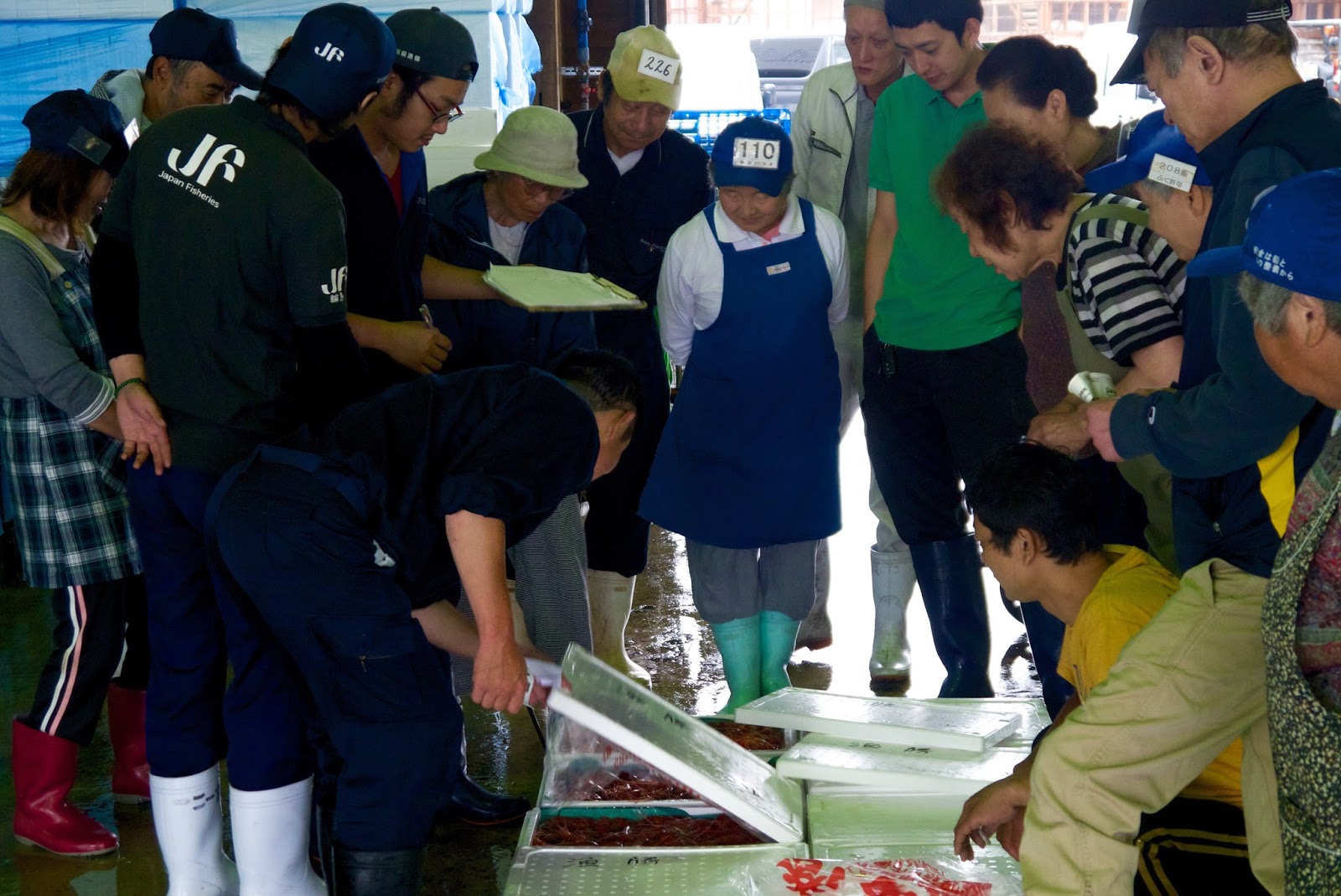
Wajima being a fishing port on the Japan Sea, it is little wonder that there is a fish auction every morning, or at least when it is possible to land a catch.  The fish are sold in lots to local and distant traders as well as to the owners of eateries and establishments providing traditional accommodation in the town.  Some fish even go as far as Tokyo on the Pacific coast.

Black Kites and Crows on the look out.

Not having ever lived by the sea, I was surprised to see so many Gulls, as well as a handful of the large indigenous Crow, a lone Heron and a considerable number of Black Kites.  Where I live in England we often sea Red Kites which are now thriving having been reintroduced some years ago after a long absence.  On the Noto Peninsula, however, the Black Kite is never far from view, often to be seen circling in twos and threes high overhead.

All the birds were waiting for scraps or fish which were discarded for being too small or too damaged to go to auction.  The Black Kites swooped low over the sea-water drenched concrete wharf to grab fish, while some of the bolder Gulls snuck into the shed to nick a bit of squid or even to gulp down small fry before someone came too close for comfort.

Flying Fish counted off by the weighed basket.
All eyes were on the boxes of shrimps.
Equally eager to see what was being offered were the traders.  They gathered in small groups to discuss and peruse the days catch which had be divided by variety or size of fish into ice-laden polystyrene trays.  At six-thirty an auctioneer and assistant appeared.  Both were representatives of Japan Fisheries and unexpectedly young.  Both also wore their baseball caps back to front and added an almost comical and relaxed air to the proceedings.  They moved along each row of trays surrounded by the keen buyers who were ready to cast a bid or even a joke or two. The auctioneer had a stick to identify the tray that was being auctioned, while his assistant diligently recored who had bought which tray.  The small swarm of buyers, some with their registration number fixed to their head gear, followed shouting their bids.  Those who had made a purchase quickly removed their buy to a waiting trolly, bicycle or light truck.  And before long the auction was over and everybody dispersed.

A large cluster of Gulls bobbed on the water of the harbour, the Crows were nowhere to be seen and the Kites were already distant specks in the cloudy morning sky.  The Heron had probably left to search for frogs in a distant rice paddy.  The excitement was over for another day.

Bill Tingey Photo © Copyright


Do feel free to pass on the address of this blog to anyone you think will be interested.  Should you wish to leave a comment, please do so by clicking on the comment mark at the bottom left of this or any of the other posts.   If you have found this blog interesting, why not become a follower.

19/06/2015

Snapshot 3: What have I been doing?


What have I been doing?
Yesterday, I spent a day working in the Shioyasu workshop.  With a history of over 150 years, it is one of the largest workshops in Wajima and has an extensive showroom.  During the tourist season buses come loaded with tour groups who are anxious to learn about lacquerware.  In some cases the groups of Japanese who come actually have either very little or no real knowledge of where lacquer comes from or how it is used to make what are iconic pieces of tableware, which have been used by the lowly as well as the noble for centuries in Japan.

One of the main features of Wajima Lacquerware is just how robust it is.  Working with a wooden core, a ground is built up using a local backed earth mixed with lacquer on top of which several more layers of lacquer are applied.  This gives it its strength.


A fine but flexible cotton cloth is applied to the core using lacquer and the ground is built up on that initial application.  That’s what I was doing yesterday.  I sat on the floor at a low bench and applied the cotton cloth to the back of blanks of a small egg-shaped mirror.  I managed to complete 65.  My mentor—Mr. Sakamoto sitting in the back of the top picture—was delighted not only with the number that I was able to complete but also because I managed to do it like a “professional” using a wooden spatular.  I have a feeling it was beginners luck.  My achievement, however, was not the only result of my efforts.  Having sat on the floor all day I suffered with back pain today.  Nevertheless it was definitely worth it.

Shin’ichi Shioyasu, Bill Tingey Photo © Copyright


Do feel free to pass on the address of this blog to anyone you think will be interested.  Should you wish to leave a comment, please do so by clicking on the comment mark at the bottom left of this or any of the other posts.   If you have found this blog interesting, why not become a follower.

18/06/2015

Snapshot 2: Who have I met?


Who have I met?
Well, so far I have met more than 50 individuals but this one was rather special.  He graces the lid of a natsume—a small tea caddy used for the powdered tea served at a tea ceremony.  The monkey is rendered by chasing the hard true lacquer with very sharp tools of various sizes.  Called chinkin in Japanese, this fine piece of work was skilfully produced by Kazutaka Furukomi.  The lacquer must be hard but not too hard so that it makes the chasing more difficult.  Having chased the design, lacquer is rubbed into the depressions.  Then, using a small wad of cotton, a very fine gold powder is rubbed over the motif, which reveals itself on the surface.

Kazutaka is lucky enough to have a strong fan-base for his work and a figure of around one million yen for such a piece does not deter a buyer.  Worth it?  Well yes, because it will be used and cherished, most likely for several generations.

I was very pleased to meet the monkey, Kazutaka and his wife, Sachiko.  And then there were the four cats, who appeared at various times but were not allowed free rein in the room where Kazutaka works.  After all, cat hair flying about is no match for the golden coat of a monkey.  It would only be an annoyance.

Bill Tingey Photo © Copyright


Do feel free to pass on the address of this blog to anyone you think will be interested.  Should you wish to leave a comment, please do so by clicking on the comment mark at the bottom left of this or any of the other posts.   If you have found this blog interesting, why not become a follower.

Snapshot 1: Where am I?


Where am I?
The easy answer to this question is I’m in Wajima on the Noto Peninsula.  I’ve been here since 3rd June.  I had hoped to be able to write several features while I am here but it’s only now that I have had enough time and energy to actually sit down and write something.  For the time being I have decided to produce a number of Snapshots—short pieces about some of the things, people and places I have been lucky enough to see.  I’ll write longer more detailed features in due course.

This shot is of some of the traditional buildings in the town of Kuroshima on the Japan Sea coast of the peninsula.  The coast-hugging road is new and actually runs along the back of a number of properties that in the past had direct access to the sea for the purpose of trade.  The main street is some 50~60 meters back from this road and only has a single lane.

A setting sun and a good deal of photographic licence has produced a dramatic shot, which reminds me of a painter's work, but I can’t think who it is.

Bill Tingey Photo © Copyright


Do feel free to pass on the address of this blog to anyone you think will be interested.  Should you wish to leave a comment, please do so by clicking on the comment mark at the bottom left of this or any of the other posts.   If you have found this blog interesting, why not become a follower.

19/05/2015

On Design—Aesthetics

This is the first of what will be several articles on design and some of the underlying aesthetic criteria which I feel consciously and unconsciously guide the endeavours of creative people in Japan, especially in the disciplines of craft, design and in some cases architecture.

Qualities Shared
It was not until I was about to leave Japan after a 24 year-stay that I suddenly realised that there was an unexpected relationship between Japan and my childhood. 

Sadly by the time this photo was taken in the early 1960s, the wooden perimeter fence had be replaced by wire just visible to the left.  The steam locomotives, too, were also about to be replaced by diesel traction.
When I was a child, I lived with my parents and sister in Hatfield, about 33 km north of London.  When I was seven we moved to a house close to the main railway line between London and Edinburgh.  Even before that my paternal grandmother often took me and my cousin to watch the trains when she looked after us.  This treat was clearly pivotal because as I grew older, I would take every opportunity to go and stand by the railway and do what many young boys and some not so young men used to do, and that was train-spotting—simply collecting the numbers of the engines seen and underlining them in a book published for the purpose.

Hatfield Station had an engine shed, where locomotives were stabled over night.  All the paraphernalia needed to service the engines including wagons full of coal, produced an inevitable overall mantle of grime and oil as well as smoke and steam that added so much atmosphere to the whole setting, creating a complex and animated backdrop through which gleaming express trains thundered or unkempt goods engines trundled with their loads.  There was precision, there was patina, there was what today is called “shabby chic”, flaking paint, evocative graphics, sooty matt surfaces, bright gleaming metals, and all manner of sights, sounds and smells amalgamated into a total experience.

Glossy true lacquer, rustically daubed wall, printed paper, ageing—elements of a tea room seen as an abstract composition.  Okochi Sanso Villa, Kyoto.
I know it is difficult to picture just how this railway setting could have anything to do with what I was later to encounter in Japan but it did.  I know it did.  More than anything else it was the qualities of all the materials in this theatre of railway, but most especially the wooden fence beside the line.  Even now it seems to be the vital connection between my early childhood and the materials used in traditional Japanese architecture.

Weathered wood and metal at 
Zentsuji Temple 
on the Island of Shikoku.
This perimeter fence was made of thick, slightly spaced upright boards standing around two meters high.  The boards were dark, almost black and heavily weathered—their surfaces finely ridged where the softer parts of the grain had wore away.  Those who have been to Japan, will realise that I could easily be describing the finish of the timber of one of Japan’s ancient temples or folk houses.

So, I would say that I found in Japan what represented some of my happiest and most satisfying moments I experienced as a child.  Without trying to explain this by delving into the depths of psychology, about which I know very little, I feel this is the reason why so much of what I encountered in Japan gave me a feeling of deep satisfaction and contentment, when I first visited Japan and even now.


The asymmetrical arrangement of the Pagoda and Main Hall at Horyuji is a compositional feature peculiar to Japan—fundamentally characteristic of a Japanese architectural composition.
Japan’s timber buildings were not, of course, built with weathered timber.  In the case of a temple like Horyuji, which is now more than 1,300 years old, the wood was originally painted, although now there are very few traces of any colour on its buildings.  It seems that no one considered that it was important to repaint it.  It was allowed to grow old gracefully and, interestingly, the natural ageing of such a building in Japan is revered just as much as newness and renewal are admired.

In a sheltered corner at Horyuji 
there is still some paint on 
the bracketing.
But not everything in Japan is as rustic as that fence beside my childhood railway haunt.  The kind of beauty and precision of lacquerwork, for instance, in some way echoes the finely lined and painted body of an express locomotive.  The polished metalwork and appealingly aged appearance of all that I found beside the railway is, I feel, often represented in Japanese crafts, design and architecture.


Just like any other country or region, the culture of Japan has an assemblage of aesthetic standards that can be recognised as guides as to what the people consider “beautiful”, but not just because of how they look.  Sometimes it is because of their smell or how they feel in the hands.  All things can be judged in a multitude of ways.  I seem to share many of the aesthetic standards that exist in Japan.  Why did that happen?  Is it because of the railway line I lived near as a child or is it because of something else?

Horyuji Temple—The Pagoda is revealed as the wind blows the curtain at the entrance to the Main Worship Hall and the light from the setting sun sets off the weathered and untreated wood of the door.
All images by Bill Tingey Photo © Copyright

Do feel free to pass on the address of this blog to anyone you think will be interested.  Should you wish to leave a comment, please do so by clicking on the comment mark at the bottom left of this or any of the other posts.   If you have found this blog interesting, why not become a follower.